














 +971 52 193 88 88
 +7 925 283 88 88
Dubai welcomed 6.97 million international overnight visitors in the first eight months of 2026, according to the Dubai Department of Economy and Tourism (DET). August alone brought approximately 869,000 of them, the strongest month since February. Hotel occupancy climbed from 36% in March to 66% in August, and hotels recorded 21.61 million occupied room nights over those eight months. The comparison with 2025, when Dubai set a record of 19.59 million visitors, is not like for like: regional airspace constraints from late February 2026 cut travel to the city sharply, and the recovery only began in the spring.
The 2026 numbers at a glance
The table below is the full official picture for January to August 2026, the latest period DET had published when this article was written.
| Metric | Figure |
|---|---|
| International overnight visitors, January–August 2026 | 6.97 million |
| August 2026 alone | approximately 869,000, the strongest month since February 2026 |
| January 2026 alone | 2.00 million, up 3% on January 2025 |
| Hotel occupancy, March 2026 | 36%, the low point of the year |
| Hotel occupancy, August 2026 | 66%, equal to 89% of the August 2025 level |
| Occupied room nights, January–August 2026 | 21.61 million |
| Hotel room inventory, end of August 2026 | approximately 149,000 rooms |
These figures come from DET’s September 2026 release, as reported by Gulf News. Reading the eight-month total against the same period of 2025 is where the comparison gets complicated, and the sources are explicit about why.
VerdictFrom late February 2026 the region was affected by airspace constraints that disrupted travel across the Middle East. As reported by Gulf News in August 2026, Dubai Airports described the first half of the year as one of the toughest operating environments in the airport’s history. Any figure that spans early 2026 carries that caveat, and 2026 should not be read as an ordinary year against 2025.
Alex Shvarov, Automotive expert with over 15 years of experience
According to Tourism Analytics’ compilation of the same DET data, Dubai received 44.4% fewer international visitors through August 2026 than in the same eight months of 2025. That single figure is the clearest summary of how deep the disruption cut, and the sections below show where in the year it happened and where the recovery is visible.
Month by month in 2026
January 2026 came in at 2.00 million visitors, up 3% on January 2025. That figure was recorded before the disruption began, which is why it stands out against everything that followed, and it comes from DET’s own January 2026 tourism performance report rather than the later September release.
DET did not publish individual monthly visitor counts for February, March, April, May, June or July 2026. The only other month with a published count so far is August 2026, at approximately 869,000, described by DET as the strongest monthly volume since February 2026.
What is published for the gap between January and August is the occupancy curve, not a visitor count: 36% in March, climbing to 66% in August. That is a hotel-occupancy series, and it should not be read as a stand-in for the missing monthly visitor figures. Alongside it, DET reports double-digit month-on-month growth in visitor numbers every month since March 2026, which is a rate of change, not an absolute count.
Helpful tipIf a figure for a 2026 month between February and July looks precise, treat it with caution. DET has not published one, and this article will not invent one.
Alex Shvarov, Automotive expert with over 15 years of experience
Data for September 2026 onwards had not been published when this article was written. The DET release and the Tourism Analytics compilation both stop at August 2026.
2025, the record year
Anyone comparing 2026 against the previous year needs the full 2025 baseline in one place. DET data for the year, as reported by Gulf News and Khaleej Times in February 2026, put Dubai at 19.59 million international overnight visitors for the full year, up 5% year on year and the third consecutive record-breaking year.
December 2025 was the best month, at 2.04 million visitors, up 6%. According to Khaleej Times, it was the first time Dubai passed 2 million visitors in a single calendar month.
The hotel side of 2025 was equally strong. Average occupancy reached 80.7%, up from 78.2% in 2024. Occupied room nights rose 4% to 44.85 million. The average daily rate reached AED 579, up 8%, and RevPAR reached AED 467, up 11%. Guests stayed an average of 3.7 nights, across a hotel inventory of 154,264 rooms in 827 establishments. All of these figures are from the same DET data, with the official DET report page available alongside the news coverage.
Where Dubai’s visitors come from
The regional mix of Dubai’s visitors shifted between 2025 and the first eight months of 2026. The table below sets the full 2025 breakdown against the 2026 shares DET has published so far.
| Region | 2025, visitors | 2025, share | Jan–Aug 2026, share |
|---|---|---|---|
| Western Europe | 4.10 million | 21% | 20% |
| GCC | 2.99 million | 15% | 16% |
| South Asia | 2.89 million | 15% | 17% |
| CIS and Eastern Europe | 2.89 million | 15% | 14% |
| MENA (excluding GCC) | 2.17 million | 11% | – |
| North East and South East Asia | 1.85 million | 9% | – |
| Americas | 1.40 million | 7% | – |
| Africa | 897,000 | 5% | – |
| Australasia | 401,000 | 2% | – |
| All other regions combined | – | – | 33% |
DET’s September 2026 release gives shares only for its four largest 2026 source regions, with everything else folded into a 33% «all other regions» line; no per-country breakdown exists for 2026. South Asia and the GCC both gained share against 2025, while Western Europe and CIS/Eastern Europe held roughly steady.
DXB’s top country markets, a different metric
Dubai Airports reports its own country-level ranking, but it counts airport passengers, not DET’s overnight visitors, so the two cannot be merged into one table. In 2025, India was DXB’s largest country market with 11.9 million guests, ahead of Saudi Arabia, the United Kingdom, Pakistan and the United States, as published by Dubai Airports. That figure counts airport passengers rather than DET’s overnight visitors, so it should not be read as a measure of how many tourists stayed in the city.
Hotels, occupancy and rates
DET’s own series
DET’s occupancy figures for 2026 are the ones already covered above: 36% in March, climbing to 66% in August, against 21.61 million occupied room nights over the eight months and a room inventory that approached 149,000 rooms by the end of August. That inventory figure sits against a different, earlier snapshot: 154,264 rooms across 827 hotels for the whole of 2025. The two are different points in time, measured at different stages of the year, and should be read as such rather than as a contradiction.
JLL’s benchmark, a separate series
JLL publishes its own half-year hotel benchmark, on its own sample, and it should not be mixed with DET’s figures or treated as the same series. For H1 2026, JLL reported Dubai occupancy at 56.4%, an average daily rate of AED 701.10, and RevPAR of AED 395.70, down more than 35% year on year. For June 2026 alone, JLL put Dubai occupancy at 51.6%, ADR at AED 375.60 (down 17.1%), and RevPAR at AED 193.90, down nearly 39%.
| Series | Period | Occupancy | ADR | RevPAR |
|---|---|---|---|---|
| DET | Full-year 2025 | 80.7% | AED 579 | AED 467 |
| DET | March 2026 | 36% | – | – |
| DET | August 2026 | 66% | – | – |
| JLL | H1 2026 | 56.4% | AED 701.10 | AED 395.70 |
| JLL | June 2026 | 51.6% | AED 375.60 | AED 193.90 |
In the same report, JLL put Abu Dhabi’s H1 2026 occupancy at 66.8%, noticeably ahead of Dubai’s 56.4% on the same method. That is the one verified comparison between the two emirates this article can offer, and it stops there.
Dubai International Airport passenger traffic
2025, a record year for DXB
Dubai International (DXB) handled 95.2 million passengers in 2025, up 3.1% year on year. Dubai Airports describes it as the busiest year in the airport’s history and the highest annual international passenger traffic ever recorded by any airport. The fourth quarter alone carried 25.1 million passengers, up 5.9%, and December 2025 was the busiest single month in DXB’s history at 8.7 million passengers, up 6.1%. Flight movements for the year totalled 454,800, up 3.3%, according to Dubai Airports, as reported by Gulf News in February 2026.
H1 2026, the decline and the recovery inside it
The first half of 2026 told a different story. DXB handled 31.5 million passengers in H1 2026, down 31.3% year on year. Aircraft movements fell 32.1% to 150,600, cargo fell 28.7% to 751,340 tonnes, and bags handled fell 28.0% to 30.3 million, as Gulf News reported in August 2026, citing Dubai Airports.
Inside that decline, the recovery through the second quarter is visible month by month: passenger numbers climbed from 3.5 million in April to 4.5 million in May and 5 million in June, as international carriers gradually resumed operations.
Dubai Airports’ chief executive, Paul Griffiths, was quoted by Gulf News saying the first half of the year «tested every part of the aviation system, and demonstrated our resilience,» adding that «as capacity steadily returns across the board, demand is responding immediately.» In a later interview he said he expects DXB to rebound to around 70 million passengers by the end of 2026. That is an expectation from the airport’s own leadership, not a published outturn, and it is the only full-year 2026 outlook this article carries.
When Dubai is busy, and when it is not

The published data points to the same seasonal shape every year. December is Dubai’s peak: 2.04 million visitors in December 2025, and 8.7 million DXB passengers that same month, the busiest month in the airport’s history. January tends to stay strong, which is exactly what 2026 showed before the disruption, at 2.00 million visitors.
The summer trough is visible in the 2026 occupancy curve, from 36% in March climbing back to 66% in August. That particular climb is shaped heavily by the recovery from the regional disruption rather than by season alone, so it should not be read as a clean seasonality signal on its own. No weather, temperature or public-holiday data is published alongside these figures, so this article reports only what the occupancy and visitor numbers show.
Helpful tipIf flexible, a visitor chasing lower rates and a quieter city has the clearest published signal in the March 2026 occupancy low. A visitor chasing the busiest atmosphere has the clearest signal in December 2025, which produced both Dubai’s record visitor month and DXB’s busiest month on record.
Alex Shvarov, Automotive expert with over 15 years of experience
What the numbers mean to the UAE economy
The World Travel and Tourism Council (WTTC) projected that international visitor spend across the UAE would reach a record AED 228.5 billion in 2025, 37% above the previous peak in 2019. WTTC also expected the sector to contribute AED 267.5 billion to the national economy, almost 13% of GDP, and to support more than 925,000 jobs, according to WTTC and The National. These are UAE-wide projections, not Dubai-only figures, and no separate Dubai tourism spend, GDP or jobs number is published anywhere in this research.
What this means if you are renting a car in Dubai

None of the figures above say anything about what a rental car costs, so here is what we can add from our own side: the starting daily rate in each class we list, at current rates.
| Class | From, 1–2 days | From, 30+ days |
|---|---|---|
| Sports | AED 390 | AED 250 |
| SUV | AED 550 | AED 330 |
| Luxury | AED 600 | AED 300 |
| Convertible | AED 490 | AED 290 |
| Sedan | AED 600 | AED 300 |
| Electric | AED 750 | AED 468 |
The longer the booking, the lower the daily rate: across the fleet, a 30+ day booking costs about a third less per day than a 1–2 day booking of the same car, and on some cars close to half.
Which class fits which kind of trip
Our cheapest listed car is the Fiat Abarth 595, at AED 390 a day on the 1–2 day tier, a city-hopping option rather than anything built for a family trip. The cheapest SUV is the Audi Q3 at AED 550, a sensible fit for a small group that wants a higher seating position and more luggage space on the airport run.
For a family or a group of four travelling with luggage, the SUV class carries the volume. A Nissan Patrol LE Platinum lists at AED 890 a day on the 1–2 day tier, falling to AED 540 a day on a 30+ day booking. A BMW X7 sits above it at AED 1 090 a day on the short tier, AED 740 a day on the long one.
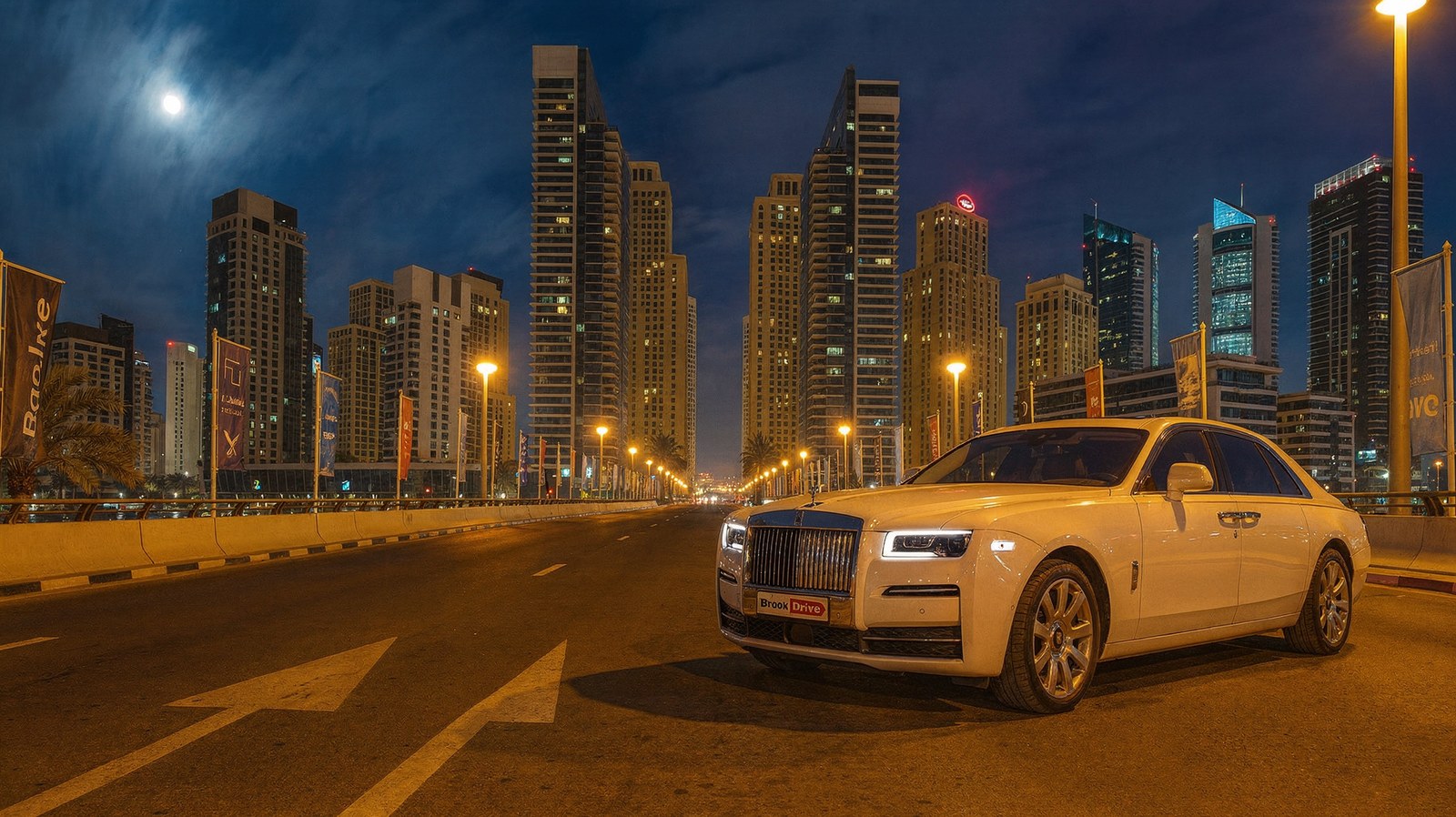
For a traveller who wants presence without going all the way to a supercar, a Range Rover HSE lists at AED 1 590 a day on 1–2 days and AED 1 090 a day on 30+ days. At the top of the published range, a Rolls-Royce Ghost lists from AED 3 000 a day on the short tier to AED 2 300 a day on the long one, which is closer to an occasion car than an everyday rental.
Anyone planning more than a short stay should look at the 30+ day rate before the 1–2 day one. The discount is real across the fleet, and for a month-long booking it is usually the figure that actually decides the class a visitor can afford.
Helpful tipCompare the 30+ day rate, not the 1–2 day rate, once a stay runs past a few weeks; the gap between the two tiers for the same car is often the largest single saving available.
Alex Shvarov, Automotive expert with over 15 years of experience
Rental terms a visitor actually needs

Deposit, insurance and age
There is no security deposit on any car we rent, and no hidden charges. Basic insurance is included in the daily rate. There is an excess that depends on the car and is set out in the rental contract, confirmed before signing; this article does not state an amount, because the amount varies by car. Extended insurance is available on request, confirmed with our team rather than published as a fixed price.
Minimum age and minimum licence experience are set per car, shown on that car’s own page, and range from 21 to 25 years depending on the model. There is no single company-wide age rule. A Mercedes C200, for example, lists at AED 600 a day on the 1–2 day tier, down to AED 300 a day on a 30+ day booking, with its own minimum age shown on its listing.
Documents, tolls and fuel
Tourists need a passport, their home-country driving licence and an International Driving Permit. Residents need a UAE driving licence and an Emirates ID.
Salik and Darb tolls are billed after the rental ends; they are never included in the quoted rate. Fuel works full-to-full: the car leaves with a full tank and comes back full. Each car carries its own mileage limit, between 200 and 250 km a day, shown on its listing, with extra kilometres charged separately. Child seats are free on request.
Delivery, handover and support
Delivery is free on rentals from AED 10,000. Below that, delivery within Dubai costs AED 185 between 09:00 and 21:00, or AED 235 overnight, both plus 5% VAT. Delivery to Dubai International Airport starts from AED 250. Handover itself takes about 20 minutes once the car arrives.
Support runs 24/7 in English, Arabic and Russian, by phone, WhatsApp and Telegram. Every rental is self-drive, and driving is limited to the UAE, so trips to Oman are not available.

Automotive expert with over 15 years of experience in the premium and sports car industry. I specialize in luxury vehicle selection, performance analysis, and creating exceptional driving experiences for discerning clients.
FAQ
How many tourists visited Dubai in 2026 so far?
6.97 million international overnight visitors arrived between January and August 2026, according to DET’s September 2026 release. No figure has been published yet for September 2026 or later.
How many tourists visited Dubai in 2025?
19.59 million international overnight visitors, up 5% on 2024 and the third consecutive record year, according to DET data reported in February 2026.
Where do Dubai’s visitors come from?
In 2025, Western Europe led with 4.10 million visitors (21% of the total), ahead of the GCC, South Asia and CIS/Eastern Europe, each close to 15%. In January–August 2026, Western Europe still led at 20%, followed by South Asia at 17%, the GCC at 16% and CIS/Eastern Europe at 14%.
What is Dubai’s hotel occupancy rate in 2026?
DET reported occupancy at 36% in March 2026, climbing to 66% in August 2026. A separate JLL benchmark put H1 2026 occupancy at 56.4%; the two series measure different samples and should not be compared directly.
How many hotel rooms does Dubai have?
154,264 rooms across 827 hotels for the full year 2025, according to DET. By the end of August 2026, DET put the inventory at approximately 149,000 rooms, a later snapshot of the same market, measured at a different point in the year.
How many passengers went through Dubai airport?
DXB handled 95.2 million passengers in 2025, its busiest year on record. H1 2026 traffic fell to 31.5 million, down 31.3% year on year, with a monthly recovery visible from April through June, according to Dubai Airports.
When is Dubai’s peak tourist season?
December is Dubai’s published peak: 2.04 million visitors in December 2025 and 8.7 million DXB passengers that month, both records. January also runs strong, as 2026 showed before the spring disruption. Summer is the quieter stretch in the occupancy data.
Is 2026 comparable with 2025?
Not directly. Regional airspace constraints from late February 2026 cut travel sharply before a recovery began in the spring, and visitor numbers through August 2026 ran 44.4% below the same period of 2025. Any comparison between the two years needs that context.
How much does it cost to rent a car in Dubai?
At Brook Drive, 1–2 day rates start from AED 390 a day for a Fiat Abarth 595, AED 550 for an SUV and AED 600 in the Luxury class. Rates fall on longer bookings: a 30+ day rental costs about a third less per day than a 1–2 day rental of the same car.
Do you need a deposit to rent a car?
No. There is no security deposit on any car in our fleet. Basic insurance is included in the daily rate, with an excess set per car in the rental contract.